
How to Select Natural Food Coloring Powder for Product Development
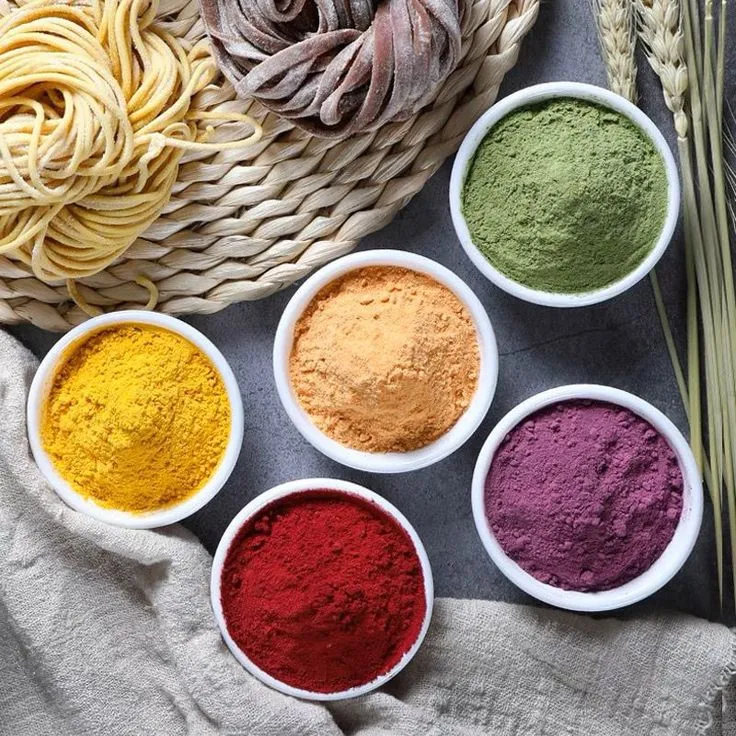
When creating a successful food product, you must make careful decisions regarding ingredients, appearance, processing and consumer presentation. For manufacturers seeking a natural food coloring powder for appropriate dry mixes, confectionery, bakery products, desserts, beverages, and more, color can play a significant role in communicating the character of a food before it is tasted. The selection of the correct powder involves consideration of the food use, the desired color, processing requirements, and production requirements.
Begin With the Product Requirements
The final product should help inform, from the outset, the process of choosing a color. Before evaluating the various ingredients, manufacturers can determine the desired color, product type, formulation properties and the method of production.
For instance, a powdered beverage might need a different set of requirements than an assortment of candies, cake mix, seasoning blend, or a preparation for a dessert. The performance of a color powder may be determined by factors such as moisture content, ingredients, mixing equipment or processing conditions.
Establishing these requirements in advance provides a structure to consider when product developers are looking at options and planning practical formulation trials.
Understand Powdered Color Ingredients
Powdered color ingredients can be integrated into existing systems that call for dry ingredients. They can be measured, mixed and incorporated as needed for the particular formulation.
The handling characteristics of each powder can vary depending on its source and preparation. Based on that, manufacturers can consider various parameters like the characteristics of the particles, storage, dispersion, measurement, compatibility with the existing production process, etc. The best solution should be based on the basis of the product itself and not just because a sample has a suitable color.
Compare Different Natural Food Colors
The manufacturers can review the natural food colors based on some characteristics other than just the color shade. The final product can be influenced by the color source, the application, the concentration of the color, the format for the color used, and the food matrix.
Various plant sources will be able to give various color families. Beetroot can be used to add red tones, turmeric can add yellow tones, and other sources, such as annatto and black carrot, can be used to add other colors.
For a developer to find a color that brings a balance to the product ingredients, flavor concept, and anticipated product appearance, it is advisable to compare several of the appropriate ingredients.
Test the Actual Food Formulation
Once a color has been selected, it’s important to test it directly in the final product being developed. An ingredient may be present in a sample container in a certain way, but a different color when added to the full food matrix.
Manufacturers can use the desired ingredients to produce a smaller batch and then test the various concentrations. It will enable teams to assess intensity, dispersion, appearance and overall suitability for color.
Testing also provides a chance to fine-tune the formulation prior to commercial production. A well-defined trial process can also result in saving development time because it can give practical information early on in the process.
Consider Processing Conditions
Some food manufacturing processes include mixing, heating, cooling, freezing, drying, baking or other operations. Such conditions should be considered at the time of assessing a powdered color.
To replicate key production processes during trials to learn about the interaction of the ingredient in the production process. The color can also be dispersed at varying points, which can alter the final appearance.
Storage conditions can be tested during the development process. When the formulation is observed after completion under the storage conditions, further information regarding the selected formulation can be obtained.
Review Supplier Information
Manufacturers can check out the product specifications, technical data, application instructions, and handling tips that are available before they start scaling up to higher quantities. This information enables the development and procurement team to determine if this ingredient meets their needs.
Availability of samples can also be beneficial, as it enables the manufacturers to assess the real product before commencing the regular purchasing process.
If the production is to be greater, there can also be discussions regarding packaging, supply capacity, ordering schedules, technical support and other aspects that can support the long-term planning.
Build Consistency into Production
After the preferred powder is decided upon, the concentration, stage of addition, mixing process, processing conditions and desired shade can be documented.
If the production specifications are clear, it will help teams to replicate the desired appearance in different batches. They can also be of assistance to future product development if similar colors are desired for other products.
When formulated in a consistent manner, the transition from formulation trials to efficient commercial production is more streamlined.
Conclusion
Many factors must be taken into account when selecting a powdered natural color, including the product, the appearance desired, the source of the ingredients, the formulation, the processing environment and the processing method. Manufacturers can gain insight into the performance of the powder in the food product through practical testing and can define a repeatable application process. If you are creating a new food formulation and researching powdered food coloring solutions, check out foodrgb.com for suitable solutions and create your product with confidence.